What is a BizMetry Domain?
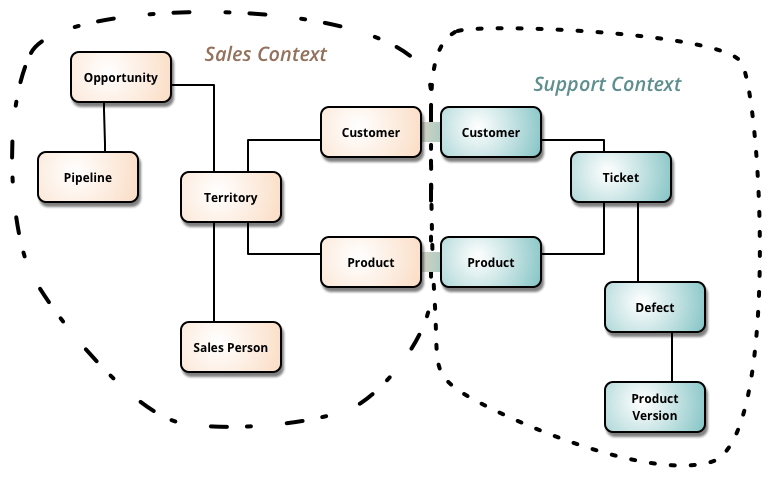
When modeling a business, assets (resources) can be grouped into Business Domains, also known as Bounded Contexts in domain-driven design terminology.
A bounded context represents a set of business assets that share common characteristics and exhibit high cohesion within a specific business area.
Concept
In BizMetry terminology, a Domain represents a distinct business area or bounded context that groups together related resources (ASBOs).
Each domain defines a logical and functional boundary within your organization — ensuring that resources belonging to it are classified consistently and tracked under the same operational and business context.
Tip
Example: In a "Retail" vertical, domains may include Order Management, Supply Chain, and Inventory, while in a "Banking" vertical, domains might include Account Management, Loans, or Trading.
Purpose of Business Domains
Modeling the relationship between Domains and Resources is critical for effective business observability.
It allows BizMetry to:
- Classify and organize resources with clear logical boundaries.
- Filter business metrics (KPIs) by domain or context.
- Create domain-specific indicators to measure performance in precise business areas.
- Facilitate context-based analytics — comparing performance across different domains.
Note
This structured classification ensures that telemetry data reflects not only what happened, but also where and within which business scope it occurred.
Managing Domains in BizMetry
BizMetry allows you to: - Create and name Business Domains that reflect your organization's real-world structure.
- Map Resources to domains dynamically — adding or removing assets as your business evolves.
- Associate KPIs and telemetry templates with specific domains for contextual tracking.
- Visualize domain-level observability metrics directly within dashboards or profile views.
Note
Domains provide the semantic layer that connects raw telemetry data with real-world business meaning.
Examples by Industry Vertical
| Industry Vertical | Example Business Domains (Bounded Contexts) |
|---|---|
| Retail | Order Management, Supply Chain, Warehouse Management, Delivery, Assurance, Inventory, Sales, Marketing, Customer Management, Product Catalog, Returns, Promotions |
| Banking & Finance | Account Management, Investments & Portfolio, Loans, ATM Management, Trading, Customer Onboarding, Payments, Risk Assessment, Compliance |
| Healthcare & Wellness | Appointments, Wellness Plans, Finance & Billing, Order Management, Client & Patient Records, Visits, Insurance Claims, Diagnostics, Medication Supply |
| Logistics & Transportation | Fleet Management, Delivery Management, Route Planning, Dispatch & Tracking, Warehouse Operations, Supplier Coordination, Scheduling, Maintenance |
| AI & Analytics | Model Hub, Grounding Hub, Integration Hub, Prompt Management, Security and Guardrails, Governance, MLOPS |
| Manufacturing | Production Line, Machinery, Parts Inventory, Quality Assurance, Maintenance Operations, Supplier Chain, Logistics Integration |
| Telecommunications | Network Nodes, Subscriptions, Billing Accounts, Device Management, Service Plans, Customer Support, SLA Monitoring |
Tip
These examples show how BizMetry helps define bounded contexts that mirror real-world organizational functions — enabling precise metric grouping and contextual telemetry.
Summary
A BizMetry Domain defines the scope of observability for related resources and KPIs.
By associating assets and metrics under a single bounded context, BizMetry allows organizations to:
- Maintain clear visibility over business processes.
- Generate actionable insights within meaningful boundaries.
- Drive business decisions aligned with domain-specific goals.
BizMetry Client–Resource–Attribute Context
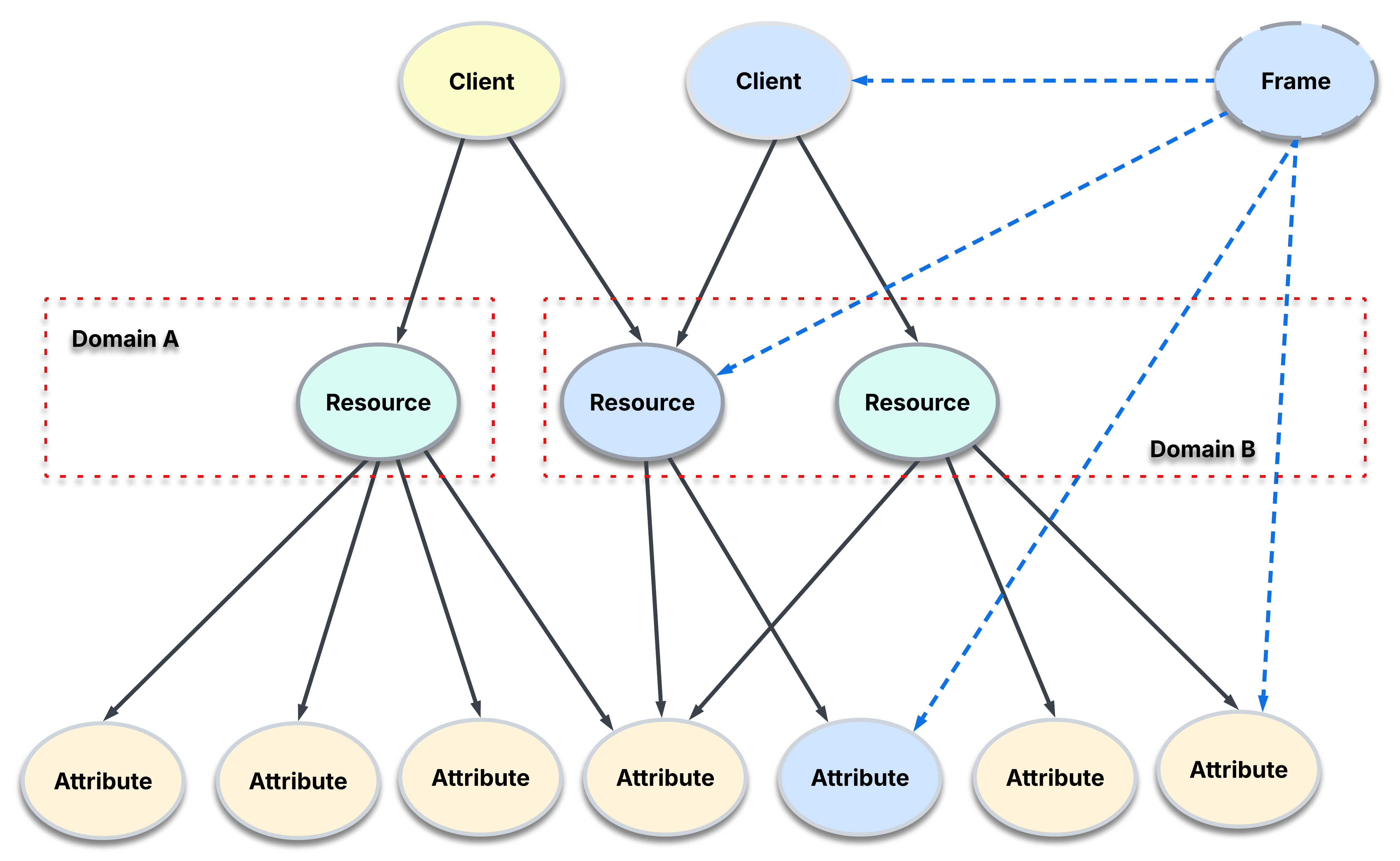
The diagram below illustrates how Clients, Resources, and Attributes interact within the BizMetry Telemetry Framework.
It highlights how clients consume business resources (assets) that, in turn, expose one or more attributes of interest — measurable indicators directly linked to key business KPIs.
In BizMetry's architecture: - A Client represents the consumer (system, app, or agent) invoking or interacting with a business resource.
- A Resource represents the business asset (ASBO) being monitored or tracked.
- Each Resource exposes one or more Attributes, which are the specific metrics or values the business wants to measure.
A Business Telemetry Frame in BizMetry associates these three elements together —
capturing the real-time relationship between a Client, a Resource, and its Attributes,
providing the foundation for business-centric observability.